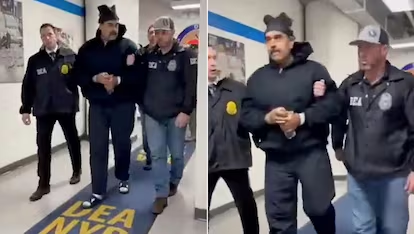
U.S. Captures Nicolás Maduro as Venezuela Crisis Deepens, First Night Spent in New York Jail
The political crisis between the United States and Venezuela escalated dramatically after U.S. authorities confirmed the capture of Venezuelan President Nicolás Maduro, who spent his first night in detention at a federal jail in New York. The unprecedented move has sent shockwaves across Latin America, global financial markets, and international diplomatic circles, marking a turning point in one of the world’s most prolonged geopolitical standoffs.
According to U.S. officials, Maduro was detained during a coordinated operation involving multiple federal agencies after allegedly entering a jurisdiction under U.S. control. While details of the operation remain classified, sources familiar with the matter described it as the culmination of years of intelligence gathering, legal preparation, and international coordination.
A Historic Arrest with Global Implications
The arrest of Nicolás Maduro represents one of the most significant actions ever taken by the United States against a sitting head of state accused of corruption, drug trafficking, and human rights violations. U.S. prosecutors have long accused Maduro of leading a “narco-state” and of playing a central role in international criminal networks, allegations consistently denied by the Venezuelan government.
Late Tuesday night, Maduro was transferred under heavy security to a high-security federal detention facility in New York, where he spent his first night in custody. Officials confirmed that he is being held under strict conditions, with limited contact while legal proceedings begin.
“This is a moment of accountability,” said a senior U.S. official, speaking on condition of anonymity. “No individual is above international law.”
Venezuela Reacts: Shock, Denial, and Protests
News of Maduro’s capture triggered immediate reactions inside Venezuela. State television initially dismissed reports as “fake news” and “psychological warfare,” but within hours, senior figures in the ruling party acknowledged that Maduro had been “illegally kidnapped” by U.S. forces.
Thousands of Maduro supporters gathered in Caracas and other major cities, waving flags and demanding his release. Security forces were deployed around key government buildings amid fears of unrest. Meanwhile, opposition leaders called the arrest a “historic opportunity” to begin a political transition after years of economic collapse and authoritarian rule.
“This could be the end of an era,” said a prominent opposition figure. “Venezuela deserves democracy, stability, and international reintegration.”
International Community Divided
The international response has been swift and deeply divided. U.S. allies including several European and Latin American governments called for respect for due process while emphasizing long-standing concerns about democracy and human rights in Venezuela.
Conversely, countries aligned with Caracas, including Russia, China, Iran, and Cuba, strongly condemned the arrest, accusing Washington of violating international law and national sovereignty. Russia’s foreign ministry described the move as “an act of aggression with dangerous global consequences.”
The United Nations called for restraint and urged all parties to avoid actions that could destabilize the region further.
Legal Battle Ahead in New York
Legal experts say Maduro is expected to face charges related to drug trafficking, money laundering, and conspiracy, potentially leading to one of the most complex international trials in U.S. history. His legal team, which is reportedly being assembled, is expected to challenge the legality of his detention and argue presidential immunity.
If the case proceeds, it could take years to resolve and set a powerful precedent for how the international community handles leaders accused of transnational crimes.
Economic and Market Impact
The arrest has already had significant economic repercussions. Oil prices fluctuated sharply as investors assessed potential disruptions to Venezuelan crude exports, while emerging market currencies in the region experienced increased volatility.
Analysts warn that Venezuela’s already fragile economy could face further turmoil in the short term but note that a political transition could open the door to sanctions relief and foreign investment in the long run.
“This is a high-risk, high-impact moment,” said an energy market analyst in London. “The uncertainty is enormous, but so is the potential for change.”
A Turning Point for Venezuela
For many Venezuelans, both inside the country and in the diaspora, the capture of Nicolás Maduro represents a dramatic and emotional moment after years of hyperinflation, mass migration, and political repression.
Whether this event leads to democratic reform or deeper instability remains uncertain. What is clear is that Venezuela has entered a new and unpredictable chapter—one that will reshape its future and redefine its relationship with the world.
As Nicolás Maduro begins his first days in U.S. custody in New York, the global community watches closely, aware that the consequences of this arrest will extend far beyond a prison cell.

Acerca del autor