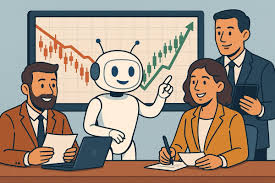
Artificial Intelligence at Work: Widespread Use, Growing Distrust, and the Corporate Challenge Ahead
Artificial intelligence is now deeply embedded in the modern workplace. From automated customer service and predictive analytics to content generation and decision support systems, AI tools are being used by employees at every level. Yet, paradoxically, as adoption accelerates, trust in these technologies is declining. Surveys across industries show a widening gap between how often AI is used and how confident workers feel about its reliability, fairness, and impact on their jobs.
This trust deficit poses a serious challenge for companies. While AI promises productivity gains, cost efficiencies, and competitive advantage, a workforce that does not trust these systems may resist their use, underutilize them, or rely on them incorrectly. Understanding why trust is eroding — and how to rebuild it — has become a strategic priority for business leaders.
Why AI Use Is Growing Faster Than Trust
One of the main reasons for declining trust is the speed of implementation. Many organizations have rolled out AI tools rapidly, often without sufficient training or explanation. Employees are told what tools to use, but not how they work or why certain decisions are made. This lack of transparency fuels skepticism, especially when AI outputs affect performance evaluations, scheduling, or customer interactions.
Another key factor is inconsistency in AI performance. While AI can be remarkably accurate in some tasks, it can also produce errors, biased outputs, or misleading results. High-profile cases of generative AI “hallucinations” and biased algorithms have made workers more cautious. When employees encounter incorrect recommendations or unclear logic, confidence erodes quickly — even if the system performs well most of the time.
Fear of job displacement also plays a role. Although many executives emphasize that AI is meant to “augment, not replace” human work, employees often see automation as a threat. When companies introduce AI without clear communication about workforce implications, trust declines. Workers may perceive AI as a cost-cutting tool rather than a productivity partner.
Finally, ethical and data privacy concerns are increasingly prominent. Employees worry about how their data is used, whether their work is being monitored, and if AI-driven decisions are fair and explainable. In regulated sectors such as finance, healthcare, and public administration, these concerns are especially acute.
The Business Risks of Low Trust in AI
Low trust undermines the return on AI investments. If employees second-guess AI recommendations, bypass systems, or rely solely on manual processes, productivity gains disappear. In some cases, overreliance combined with low understanding can be even more dangerous, leading to poor decisions based on flawed outputs.
There is also a reputational risk. Internal distrust often mirrors external perceptions. Companies that fail to manage AI responsibly may face criticism from customers, regulators, and investors. As AI governance becomes a core component of ESG and compliance frameworks, trust is no longer a “soft” issue — it directly affects valuation and long-term resilience.
How Companies Can Rebuild Trust in AI
The solution is not to slow down innovation, but to change how AI is introduced and governed.
Transparency is the first step. Employees do not need to understand every technical detail, but they should know how AI systems are used, what data they rely on, and where their limitations lie. Explainability builds confidence, especially when AI supports decision-making rather than replacing it.
Training is equally critical. Many workers use AI tools without formal guidance, learning through trial and error. Structured training programs help employees understand when to trust AI, when to challenge it, and how to combine human judgment with automated insights. This reduces misuse and frustration.
Human oversight must be visible. Trust increases when employees know there is accountability. Clear policies stating that final responsibility lies with humans — not algorithms — reassure workers and reduce fear. AI should be positioned as an assistant, not an authority.
Ethics and governance frameworks matter. Companies that establish clear AI principles, bias monitoring processes, and data protection standards send a strong signal internally. Appointing AI ethics committees or responsible AI officers can further reinforce credibility.
Finally, communication must be continuous. Trust is not built through a single announcement or training session. Regular updates, feedback channels, and employee involvement in AI design and evaluation help create a sense of shared ownership rather than imposed technology.
A Defining Moment for AI in the Workplace
The growing gap between AI adoption and trust is a warning sign — but also an opportunity. Companies that address trust proactively will unlock the full potential of AI while strengthening employee engagement. Those that ignore it risk turning powerful technology into a source of tension and inefficiency.
In the next phase of digital transformation, success will not be defined solely by how advanced an AI system is, but by how confidently people are willing to work with it. Trust, not technology, may ultimately be the decisive competitive advantage.
Acerca del autor