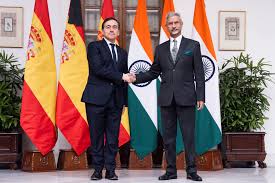
EU and India Seal Historic Free Trade Agreement, Reshaping Global Trade Relations
The European Union and India have reached a historic free trade agreement (FTA), marking a major breakthrough in one of the world’s most significant economic partnerships. The deal, years in the making, is expected to dramatically expand bilateral trade, strengthen supply chains, and deepen strategic ties between two of the world’s largest economic blocs.
EU and Indian officials described the agreement as a landmark moment for global trade, particularly at a time when protectionism, geopolitical fragmentation, and supply-chain realignment are reshaping the international economic order.
A Strategic Deal Between Two Economic Giants
The EU–India free trade agreement covers a broad range of sectors, including manufacturing, services, digital trade, agriculture, pharmaceuticals, automotive, and clean energy. Together, the EU and India represent a combined market of more than 1.8 billion people and a substantial share of global GDP.
Under the agreement, both sides commit to reducing tariffs, easing regulatory barriers, and improving market access for businesses and investors. European exporters are expected to benefit from lower duties on industrial goods, while Indian firms gain expanded access to one of the world’s largest consumer markets.
“This agreement is not just about trade volumes,” said a senior EU official. “It’s about building a long-term economic partnership based on trust, resilience, and shared strategic interests.”
Boost to Trade, Investment, and Supply Chains
Bilateral trade between the EU and India has grown steadily in recent years, but officials on both sides argue that it has fallen short of its full potential. The new FTA aims to unlock that potential by simplifying rules of origin, protecting intellectual property, and enhancing cooperation in services and technology.
The deal is also expected to accelerate European investment in India, particularly in sectors such as renewable energy, infrastructure, advanced manufacturing, and digital services. For India, the agreement supports its ambition to position itself as a global manufacturing and supply-chain hub, offering an alternative to overreliance on China.
Geopolitical Significance in a Fragmented World
Beyond economics, the agreement carries clear geopolitical weight. As global trade becomes increasingly shaped by strategic alliances, the EU–India pact signals a deepening alignment between democratic economies seeking stability, diversification, and rules-based trade.
For the European Union, closer ties with India strengthen its presence in the Indo-Pacific region. For India, the deal reinforces its role as a key global player balancing relationships with major powers while protecting its strategic autonomy.
Analysts view the agreement as part of a broader trend toward “friend-shoring”, where countries prioritize trade and investment with trusted partners.
Challenges and Implementation Ahead
While widely welcomed, the agreement will still face ratification processes within EU member states and implementation challenges on both sides. Sensitive areas such as agriculture, labor standards, and environmental commitments will remain under close scrutiny.
Business leaders, however, have largely applauded the deal, calling it a long-awaited step that provides clarity and predictability for long-term investment decisions.
Outlook: A New Chapter in Global Trade
The EU–India free trade agreement is expected to enter into force in phases, with gradual tariff reductions and regulatory alignment over time. Once fully implemented, it could become one of the most influential trade deals of the decade.
In an era marked by economic uncertainty and geopolitical tension, the agreement sends a powerful message: globalization is not ending—it is being reshaped. And at the center of that reshaping stands a strengthened partnership between Europe and India.

Acerca del autor